

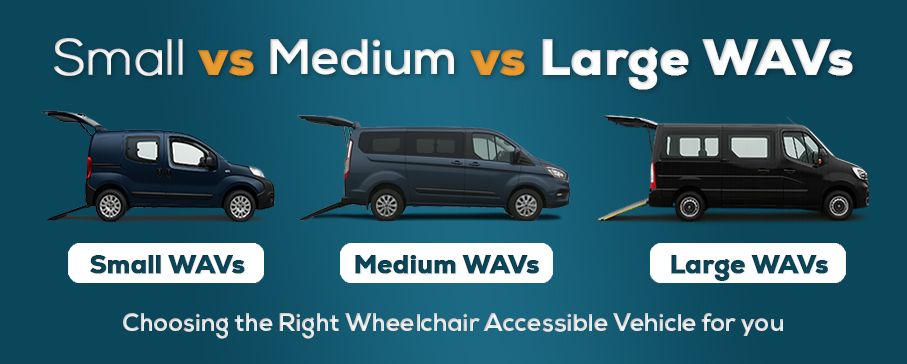
What’s the Difference Between Small, Medium & Large Wheelchair Accessible Vehicles (WAVs)?
Small, Medium & Large WAVs Explained - Wheelchair Accessible Vehicle Size Guide
Choosing the right Wheelchair Accessible Vehicle (WAV) isn’t just about size, it’s about comfort, accessibility, and making your daily life easier. Whether you're a disabled driver, carer, family member, or organisation providing accessible transport, understanding the difference between small, medium and large WAVs is essential to finding a vehicle that meets your needs. In this guide, we’ll break down each WAV size category, explore use cases, highlight popular models, and help you decide which WAV is right for you.
What Is a Wheelchair Accessible Vehicle?
A Wheelchair Accessible Vehicle (WAV) is a specially converted car or van designed to accommodate a wheelchair user. Unlike standard vehicles, WAVs feature adaptations like:
- Ramps or lifts for easy entry
- Lowered floors or raised roofs for headroom
- Wheelchair restraint systems for safety
- Flexible seating layouts to accommodate carers or passengers
- Uniquie conversions to allow for passenger up front or driver transfer options
WAVs are available in a variety of sizes to suit different mobility needs, and that’s where understanding the differences between small, medium, and large WAVs helps.
Why Choosing the Right Size WAV Matters
The size of your WAV can impact:
• Accessibility: Space to enter and move comfortably in the vehicle.
• Practicality: Daily use, parking, and ease of driving.
• Passenger Capacity: For families, carers, or group travel.
• Storage: Space for mobility aids, medical equipment, or luggage.
What Is a Small WAV?
Small WAVs are typically converted from compact cars or MPVs. They’re ideal for individuals or families who need a vehicle for daily personal use, without sacrificing driveability.
Use Cases & Benefits:
- Usually more cost-effective
- Easier to park and manoeuvre
- Great for individuals, couples, or small families
Popular Small WAVs:
- Fiat Qubo / Doblo
- Citroën Berlingo
- Peugeot Partner
These vehicles typically offer:
- A single wheelchair space
- Manual or lightweight ramps
- Lowered floors for better headroom
Space Expectation (Approx.):
Headroom: ~135–140 cm
Entry Width: ~75–80 cm
Ideal for: Standard-sized wheelchairs and short journeys
What Is a Medium WAV?
Medium WAVs are built from longer, more spacious vehicles but remain easy to drive and versatile. These are great for family travel, care providers, or businesses like accessible taxis.
Use Cases & Benefits:
- Extra headroom and flexibility
- More space for passengers and luggage
- Great for wheelchair users with carers or companions
Popular Medium WAVs:
- VW Caddy Maxi
- Peugeot Expert
- Ford Tourneo Custom (standard wheelbase)
Expect features like:
- Extra seating options (3+ seats in addition to wheelchair space)
- Manual or electric ramps/lifts
Space Expectation (Approx.):
Headroom: ~140–145 cm
Entry Width: ~80–85 cm
Ideal for: Powerchairs, larger wheelchairs
What Is a Large WAV?
Large WAVs are converted from full-size vans. They offer maximum space and are frequently used by care homes, schools, and patient transport specialists who need room for multiple passengers and medical equipment.
Use Cases & Benefits:
- Supports larger wheelchairs or multiple wheelchair users
- Ideal for organisations, group transport, or specialist care
- Electric tail lifts, higher ceilings, and configurable layouts
Popular Large WAVs:
- Renault Master
- Peugeot Boxer
- VW Crafter
These vehicles can offer:
- Multiple seating and wheelchair configurations
- Robust entry systems
- Plenty of interior space for passengers and belongings
Space Expectation (Approx.):
Headroom: ~145–155 cm+
Entry Width: ~85–90 cm+
Ideal for: Largest wheelchairs, multi-user transport, equipment storage
How To Choose the Right WAV for You
Choosing your WAV size depends on:
- Wheelchair Size & Height - Will it fit comfortably?
- Number of Passengers - Just one passenger or several passengers?
- Type of Travel - Daily local trips or long journeys?
- Future Needs - Will your space needs change over time?
Still unsure? Our WAV specialists at WavMob are here to help guide you based on your unique situation.
Why Choose WavMob?
At WavMob, we understand that choosing a WAV can feel overwhelming, but it doesn’t have to.
- Wide range of WAVs in stock - Over 180 used WAVs
- Motability Accredited - A selection of nearly-new WAVs available via the Motability Scheme
- AA Approved dealer
- Full in house WAV preparation centre
- Vehicles sourcing, part exchange, service plans & finance options
- Home demonstrations
- Supportive, knowledgeable advisors who take time to understand your needs
- Nationwide delivery with specialist handover support
Whether you're an individual, family or organisation, we’re here to make mobility simple.
View Our WAVs by Size
View Small WAVs | View Medium WAVs | View Large WAVs
Or call/email us to speak with a friendly WAV specialist today.
FAQs
What’s the difference between a WAV and an adapted car?
WAVs are built specifically to carry a wheelchair user inside the vehicle, while adapted cars may have driving aids but not necessarily space or access for a wheelchair.
Can a wheelchair user drive a WAV?
Yes. Some WAVs are designed for drive-from wheelchair or internal transfer, but not all. Speak with a WavMob specialist to find the right one.
How many seats does a WAV have?
Depending on size, most WAVs have 1–9 seats in addition to the wheelchair space.
Can I finance a used WAV?
Yes, WavMob offers finance options for most used WAVs to help spread the cost, find out more here.
Do WAVs require special insurance?
Not necessarily. However, it’s best to use an insurer that understands the vehicles adaptions to ensure proper coverage. Fish Insurance is one example of WAV insurers.
Choosing between a small, medium or large WAV depends on your lifestyle, needs and mobility equipment. From compact daily drivers to large transport vans, WAVs offer flexibility for everyone. At WavMob, we’re here to help you find the one that fits just right.