

Ultimate Guide to Car Tyre Safety 2021
With winter soon approaching, we will no doubt be experiencing frost, heavy rain, and maybe, just maybe even some snow. In adverse weather conditions such as these, it’s more vital than ever to make sure we are travelling safely – and that entails keeping our tyres in good condition.
Our vehicle's tyres are the only thing connecting your car or van to the road. We cannot stress enough the importance of looking after your tyres and conducting health checks regularly to ensure your safety and get more value for money in terms of fuel economy and lifespan.
Tyres are a vital, high-quality, expertly engineered chassis component that is specially tailored to modern cars. Not only do they have to match different suspension systems and respond precisely to steering instructions, but they also need to roll smoothly and be durable.
Above all, for cars and vans to remain securely and safely on the road, tyres need to be able to cope with the forces used on them – when accelerating, braking or cornering. This is especially important when the road is wet and slippery or covered in ice or snow.

According to statistics from TyreSafe, nearly 1,000 drivers are seriously injured or killed in accidents annually due to tyre-related issues. If that statistic wasn’t shocking enough, TyreSafe also reported that 2.2m motorists fail their MOTs every year due to tyre defects, which shows that we need to give more attention to our tyres.
According to statistics, 14% of vehicles on UK roads are currently driving around on unsafe or illegal tyres. Aside from the three penalty points and £2,500 fine per tyre, this is ultimately incredibly dangerous to the driver, passengers and other road users.

So, with your safety in mind, here is a valuable guide to help you look after your tyres and keep safe on the road.
What is the minimum tyre tread depth?
By law, you need a minimum of 1.6mm of tyre tread around the central three-quarters of the tyre.
However, we recommend leaving no less than 3mm of tread before deciding to book into a garage for a tyre replacement. Why? Because that 1.4mm of depth can significantly impact your vehicle’s stopping distance, performance, and general control.
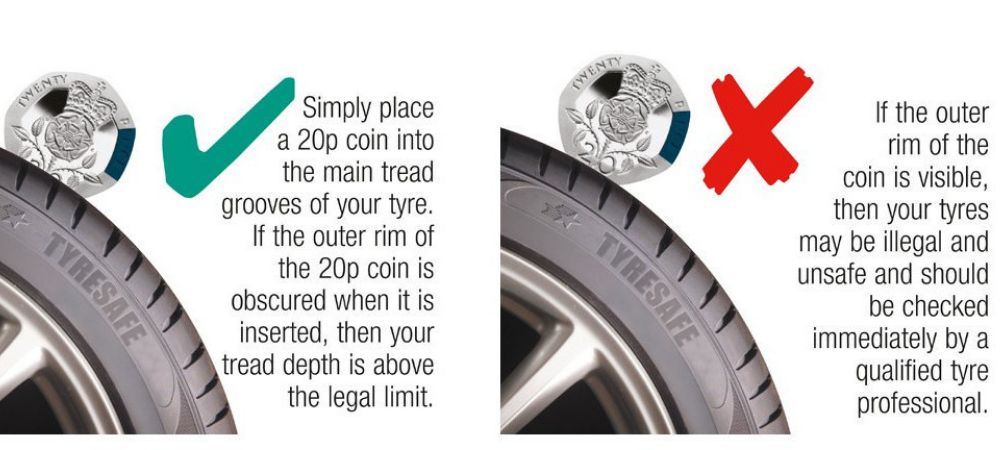
Checking your tread depth is simple. Just conduct the 20p test! The outer rim of a 20p coin measures precisely 1.6mm, so if it’s visible when placed between the grooves of your tyre, this means that your tyres are indeed illegal.
Motorists should check in several spots on each tyre as they can wear unevenly.
Why is tread depth so significant?
Sufficient tread depth is vital for good grip on wet roads. The tread pattern helps remove water from between the tyre and the road surface — drivers with inadequate tread depth face longer stopping distances, reduced grip and an increased risk of aquaplaning.
How often should I check my tyres?
"Tyres can typically lose around one to two PSI [Pounds per Square Inch] a month.
I would recommend drivers check their tyre pressure at least every fortnight to check there isn’t an abnormal loss of pressure or a slow leak," says Stuart Devereux, Sales Manager at WavMob.
"Motorists should also visually inspect their tyres by looking at the sidewall to ensure there are no cracks or lumps, and looking at the face of the tread to check nothing is piercing the tyre."
How do I check my tyre pressures?
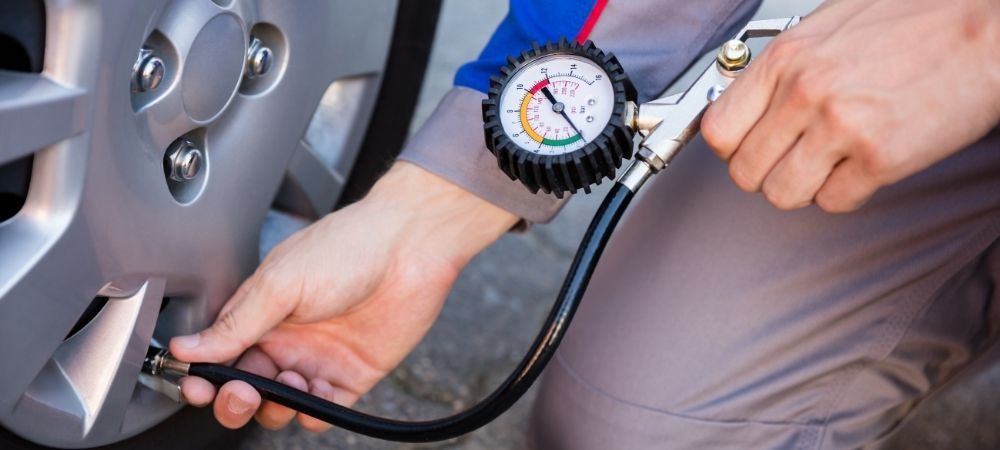
- Use a pressure gauge. Either buy one of your own or use one at your local garage.
- Take a reading when the tyres are cold. Tyres get warmer as you drive, which can alter the reading. First thing in the morning is typically the best time to check.
- Unscrew the valve cap and place the gauge over the valve. Don’t worry if you hear a bit of hissing – that’s normal.
- Read the pressure on the gauge and compare it with your tyre’s recommended bar or psi. Some gauges provide readings in both bar and psi. Make sure yours is on the correct setting.
- Put more air in or out if you need to, either using your own air compressor or by going to your local garage.
- Re-check your pressure with the gauge and check against the manufacturer’s specifications.
- Replace the valve caps on each tyre.
- Check each tyre. If your tyre pressure is dropping too much, ask your garage for help. It could be because of ill-fitting rims or a faulty valve or puncture.
How do I find the recommended tyre pressures for my vehicle?
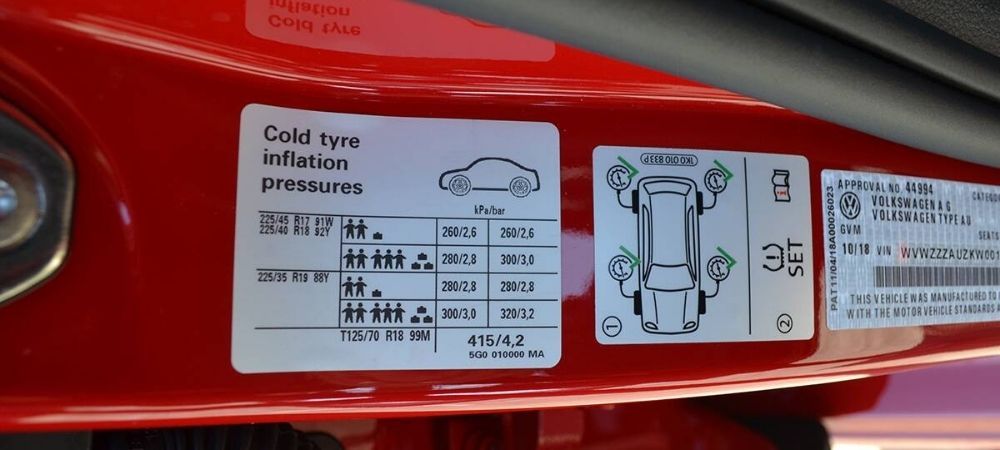
You can find the recommended tyre pressures for your car or van in your vehicle's handbook. Alternatively, the tyre pressures might be visible on the inside of the driver side door or, in some cases, printed on the inside of your petrol tank flap.
Your vehicle manufacturer may recommend maintaining your front and rear tyres at slightly different pressures for optimal performance.
What causes tyre wear and damage?
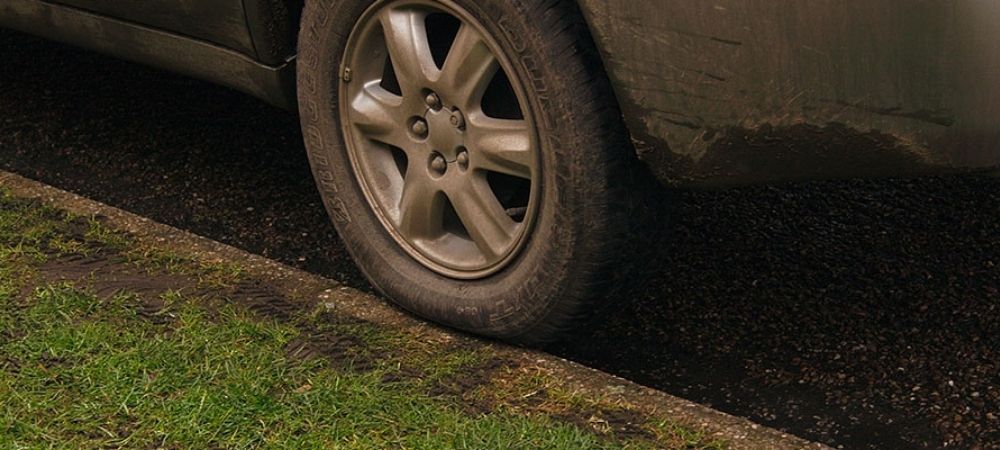
Many factors can cause irregular wear and tear to your tyres. A few examples are repeated scuffing of tyres against kerbs, aggressive driving, misaligned steering, the under or over-inflation of the tyre, and worn suspension parts. There are so many variables that there isn't one single answer.
Should you run a tyre to the legal limit?
As mentioned above, the legal limit for tread depth is 1.6mm. Until recently, all tyre manufacturers, motoring groups and tyre suppliers recommended tyre replacement at 3mm.
However, because of recent developments in tyre compound technology, some manufacturers are now disregarding this advice.
For example, Michelin claims that its tyres are designed to provide as-new performance to the 1.6mm limit. The French tyre manufacturer is also campaigning for EU tyre ratings to be adjusted to reflect worn performance for all tyres at 1.6mm.
Ultimately, whether you replace at 1.6mm, 2mm, or 3mm is down to your own personal preference and the tyre's quality fitted to the vehicle. However, it's critical to note that tyres near or on the legal limit can be more susceptible to aquaplaning because there is less tread depth to allow for water dispersion.
For example, a tyre with 1.6mm of tread will not perform as well as one with 3mm when faced with a road that may have 2mm of water on its surface.
How long do tyres last?
How long a tyre lasts depends on your driving style and the type of vehicle you're driving. According to Michelin, an average tyre should last around 25,000 miles. However, if you don't use your car very much, then tyre manufacturers' recommend that all tyres be replaced after ten years, regardless of the tyre depth.
We would recommend getting all of your tyres inspected each year if they are older than five years.
How does tyre pressure affect fuel consumption?
Ensuring your tyres have the manufacturer recommended pressures will help you benefit from optimum fuel consumption.
Did you know that underinflated tyres can affect the vehicle's rolling resistance? Rolling resistance is the energy your car expends to keep your tyres moving at a consistent speed. Keeping your tyres at the right pressure will help ensure your vehicle uses less energy and, therefore, less fuel to keep your vehicle moving.
What are the common types of tyre defects I should look for?
Tyre damage can be in several forms and have different levels of severity. The chances are your tyres will incur some damage during their lifespan, regardless of how safe a driver you are. Whether potholes cause damage, debris on the road, or a road traffic accident, you should be prepared to inspect and identify the various types of tyre damage.
Bulges, lumps and cuts
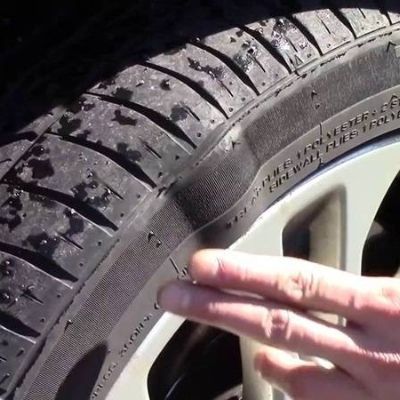
Bulges in tyres can happen if the sidewall becomes damaged, often due to potholes in the road or by ‘kerbing’.
The structural integrity of the tyre sidewall is weakened, and the internal air pressure creates a noticeable bulge. A lump or a bulge indicates the tyre typically has been damaged internally.
Suppose you spot a lump, bulge or a cut in your tyres - you need to get the tyre repaired or replaced promptly. You must also have the tyre checked immediately if you spot rips, cuts, and tears due to pothole damage or 'kerbing’.
Any cut deep enough to reach internal structure renders tyres unsafe and in need of replacement.
Camber wear
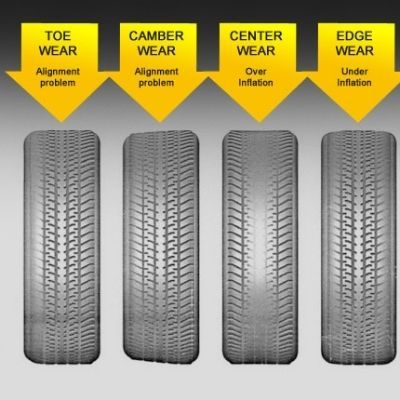
Look out for: The tyre's outside edge or inside edge will show much more wear than the rest of the tyre if your tyre is experiencing camber wear. Typically you would see a gradual slope from one side of the tyre to the other, and it's usually easy to spot.
Possible causes: Camber wear is generally caused by a bent strut, suspension misalignment, a weak or broken spring, a dislocated strut tower, a collapsed or damaged control arm brushing or a bent spindle.
What to do: The causes of tyre camber wear can be very severe and affect the performance and safety of your vehicle. It is crucial to get your car, or van checked at an approved garage to discover the cause of the problem by checking the suspension and its alignment.
Centre Tread Wear
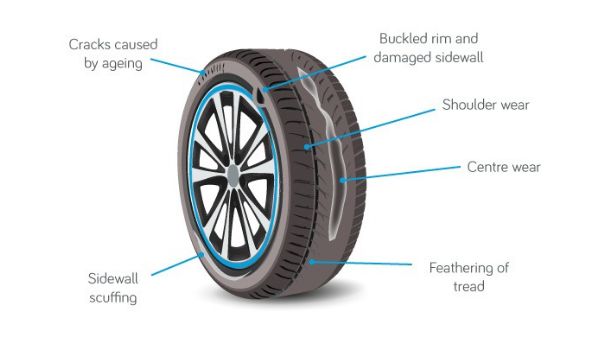
Look out for: Extreme wear down the centre of the tyre with less wear visible on the outer tyre edges.
Possible causes: Centre tyre wear is often caused by the overinflation of tyres. This can lead to a bulge in the centre of the tyre, causing the centre to take more pressure and wear more quickly than the outer tyre edges.
What to do: Try to check your tyre pressures at least fortnightly. If you have to inflate your tyres, keep them within your manufacturer's recommended tyre pressure guidelines, which you can find in the car's manual or inside the driver's side door.
Cupping Tyre Wear
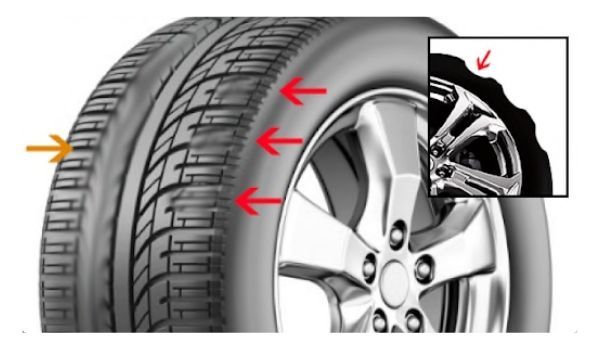
Look out for: With cupping tyre wear, you need to look for cups or dips around the edge of the tyre tread. Cupping wear does not follow a particular pattern, so you must inspect the entire tyre for signs of cups or dips.
Possible causes: Cupping tyre wear is typically caused by one of the tyres being out of balance with the others. However, it could also be due to impaired struts or shock absorbers.
What to do: Cupping can highlight an issue that soon becomes extremely serious if left untreated, which is why you should promptly take your car to an approved garage to get your tyres checked. A technician should be able to confirm whether your tyres need re-balancing or if you have weakened struts or shock absorbers, in which case these may need replacing.
Outer Tyre Wear
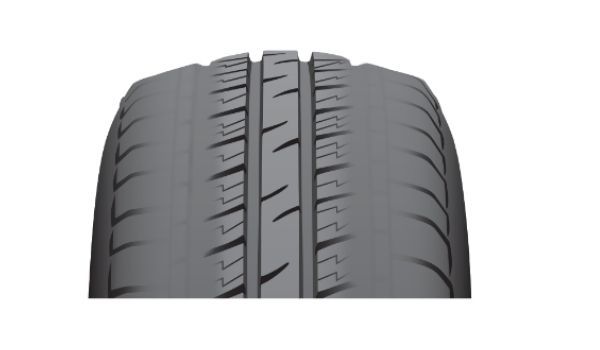
Look out for: The outer edge of the tyre will wear more swiftly than the centre of the tyre.
Possible causes: Outside tyre wear is often caused by underinflated tyres which can create a dip to occur in the centre of the tyre. This dip has less contact with the road, so it does not wear as fast while putting more of the car's weight on the outer edge of the tyre, causing more wear.
What to do: Try to inspect your tyres every couple of weeks and keep the tyre pressure set to what the manufacturer has recommended. If you are not confident checking the tyre pressures on your vehicle, try to find a local garage that offers a free check.
You may also find your tyres susceptible to patchy wear, i.e., random wear of the tyre with no clear pattern. This typically indicates a tyre is out of balance, so you should take your vehicle to a garage to get your tyres rebalanced.
Flat Tyres
Many motorists have had at least one flat tyre during their driving history. However, you can avert the dreaded flat tyre scenario through sensible driving decisions, and good maintenance practices will also help decrease the risk of punctures and blowouts.
- Check your air pressure in each tyre at least once a month
- Inspect your tyres for uneven wear and good tread once a week and after any notable knocks
- Avoid driving on roads with recent construction activity and rough surfaces
- Try and identify obvious puncture hazards while driving, but don’t take evasive action unless it's safe to do so
Don't overload your vehicle
It is vital not to overload your vehicle and the weight of your tyres carrying capacity. Abnormal flexing under heavy loads damages tyres, and the edges of the tread can generate extreme heat and possibly start separating from the tyre.
Cords in the sidewalls can begin to break, and once this begins, it could continue, even after you remove the excessive load.
An overloaded car or van is harder to handle, especially in emergencies calling for quick manoeuvring. And the vehicle's springs and shock absorbers may be strained to the point of actual damage.
By consistently using tyres on the top of their weight limit, it degrades tyres the same as overloading them for a short time. If a tyre has already been underinflated or damaged, even a small extra load can lead to a blowout. So it’s key to adjust your tyre pressure depending on the weight you have added.
Should I change my tyres all at once?
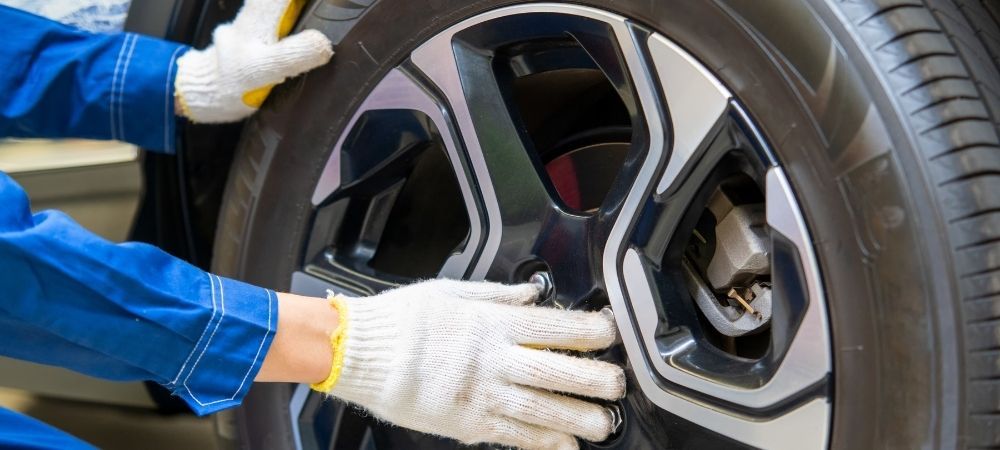
It’s more desirable to fit all four tyres simultaneously, but if that is not feasible, fitting a pair of tyres to get the best handling and grip on each axle, is your next best option. You can replace a single tyre, but this should be a last resort. For all circumstances, obtain the advice of an expert tyre retailer before replacing any tyres.
Which is the best axle on which to place new tyres?
It's best practice for new tyres to be fitted on the rear axle as it provides improved driver control on wet roads. This is because tyres with deeper treads are more reliable at displacing water and offer an improved grip. If you have the new tyres fitted at the front of the vehicle, it is more likely to oversteer when grip is lost in wet conditions, which is much harder to control than understeer. Oversteer is when the car's rear slides sideways, and understeer is when the front of the car slides.
It’s more desirable to fit all four tyres simultaneously, but if that is not feasible, fitting a pair of tyres to get the best handling and grip on each axle, is your next best option. You can replace a single tyre, but this should be a last resort. For all circumstances, obtain the advice of an expert tyre retailer before replacing any tyres.
Should I buy part-worn tyres?
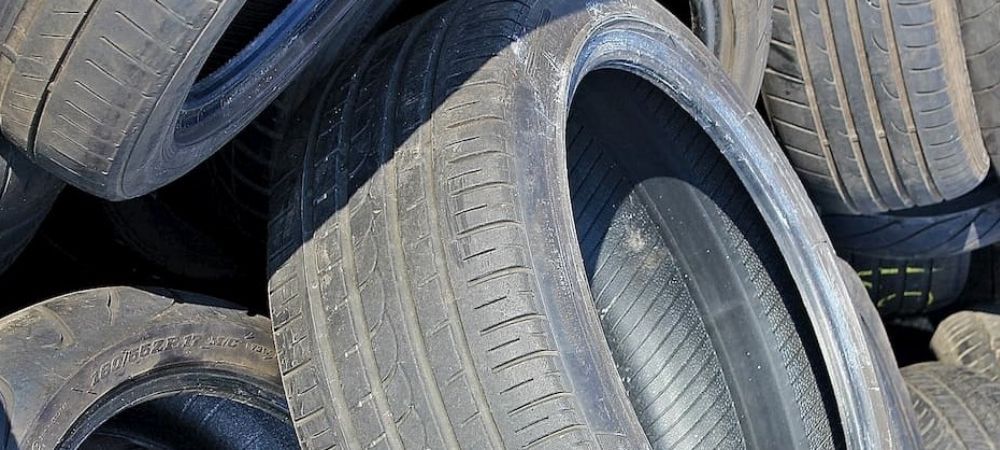
Part worn tyres might seem like a cheaper alternative, but they can be a potential accident in the making.
Tyres are essential in keeping you, your passengers and fellow drivers safe on the road. They are the only part of the car in contact with the road, and an awful lot relies on their condition.
Although it is not illegal to sell a part-worn tyre in the UK, legislation has been put in place to permit the sale, subject to the tyres meeting several strict criteria. However, the number of unlawful part worn tyres sold is disturbing and poses a severe safety risk to drivers.
A survey recently carried out by TyreSafe found that 98% of part worn tyres they checked were sold illegally - with 34% of the tyre containing hazardous forms of damage.
At WavMob, we feel very strongly on this subject and actively encourage drivers to purchase new tyres instead of part worn ones.
What happens if I get caught by the police with defective tyres?

Being a careful and responsible driver doesn’t start or end with what you do when you are behind the wheel. It begins before you even get into the vehicle as you need to ensure that your car or van is roadworthy.
According to the Road Traffic Act 1988, it is an offence:
“To use cause or permit another to use a motor vehicle or trailer on a road which might for whatever reason, involve a danger of injury to any person”.
This makes it illegal to use a vehicle in a poor mechanical state and could be considered dangerous to your passengers or other road users.
Driving a car or a van with faulty tyres would make you guilty of committing this offence. So please make sure that you undertake regular tyre checks each fortnight and know what to look out for to keep your vehicle roadworthy.
The penalties for motoring offences related to the use of faulty tyres on vehicles are incredibly severe. If the police stop you, you could end up seriously out of pocket and possibly banned from driving – depending on the number of tyres affected and the severity of the damage. In addition, getting caught driving with illegal tyres could increase your insurance premiums.
Drivers can be fined up to £2,500 for each faulty tyre and three points placed on their driving licence. If the police find another tyre falling short of the law, the fine doubles to £5,000, and you could get six points on your licence. Landing six penalty points on your licence might see as much as a 25% increase in your insurance premiums - ouch!
In a worst-case scenario, if the police find your vehicle has four faulty tyres, you could receive a maximum of 12 points, which would result in the loss of your driving licence.
What do the tyre markings mean?
It’s essential to understand what each rating means and how it applies to your car or van, as fitting an incorrect tyre could be unsafe. Using our image as an example, here’s what each marking means:
There are five crucial bits of information on the tyre's sidewall:
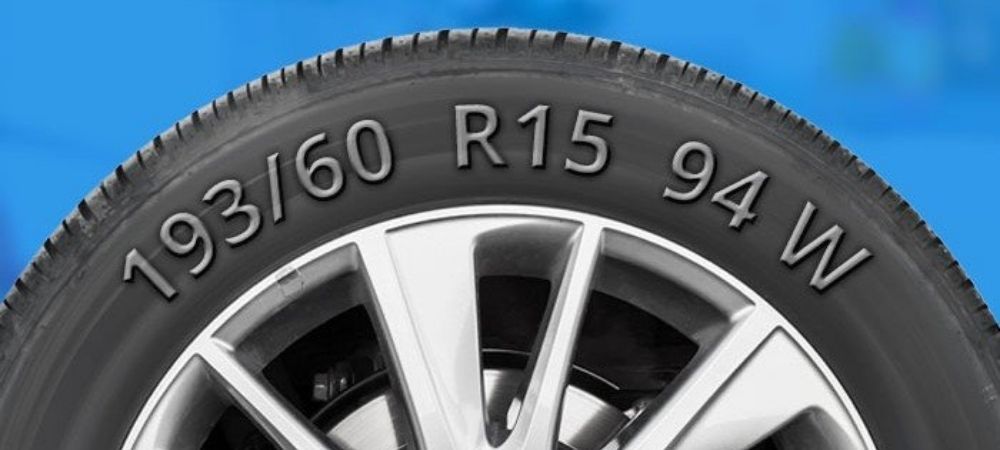
- 193 – The width of the tyre in millimetres.
- 60 – The height of the tyre sidewall as a percentage of the width of the tyre.
- R – The tyre is of radial construction.
- 15 – The diameter of the wheel’s inner rim in inches.
- 94 – Indicates the load rating of the tyre i.e. its maximum carrying capacity (in kg).
- W – Indicates the tyre speed rating.
Car tyre labels explained
All new car tyres sold in the EU after November 2012 come with a standard label or sticker attached. The label ranks the tyre on three sets of criteria:
- Fuel efficiency
- Wet grip
- External noise.
Fuel efficiency and wet grip get a rating from green A (best) to red G (worst). External noise is measured in decibels (dB).
The label looks almost identical to those found on household appliances such as washing machines. This familiar format provides drivers with enough reliable information to make an informed decision when purchasing new tyres.
Fuel efficiency

The fuel efficiency portion of the label relates to a tyre’s rolling resistance.
It shows the energy you would expect to lose when a particular tyre rolls due to day-to-day wear and tear.
Tyres with a lower rolling resistance tend to provide improved fuel efficiency and get a better energy rating. The difference between each category is typically around 3% to 4% fuel efficiency.
If you are looking for ways to make savings on fuel, take a peek at our tips to maximise your fuel consumption.
Wet Grip

The rating of the wet grip label is based on stopping distances in wet conditions.
Several factors affect stopping distance in the real world, but the main ones are tyre grip and tyre pressure.
Tyre manufacturers have the tough job of balancing rolling resistance, which affects fuel economy, road grip and stopping distance.
These two ratings are essential, as the variation between each rating from A down to G could add up to two car lengths to the stopping distance.
And, your tyres having a poor wet grip increases the chances of you making a claim on your car insurance when driving in wet weather.
External noise
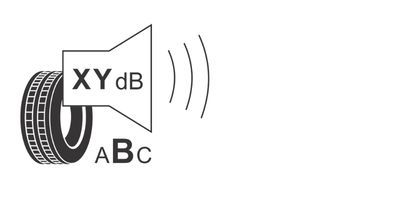
The external noise rating is measured in decibels (dB) and makes drivers more aware of noise pollution generated from a tyre.
The aim is to reduce noise from road transport. It’s represented with black sound waves, starting with one for the lowest noise level and increases up to three for the noisiest tyres:
- One sound wave: The tyre is 3dB lower than the European noise limit
- Two sound waves: The tyre is compliant with the European limit
- Three sound waves: The tyre noise exceeds the current European limit.
Driving with quieter tyres is more beneficial for those around you, and it also reduces interior cabin noise to make your journey more comfortable. As a rough guide, a 3dB increase in tyre noise could double the amount of noise the tyre produces.
Are car tyre labels changing?
Although the UK has left the European Union, we are expected to adopt the new tyre labelling system that the EU introduced in May 2021.
According to the NI Protocol, this new form of labelling has to be shown on tyres sold in Northern Ireland. UK tyre distributors have agreed to make the new label system available to all customers digitally.
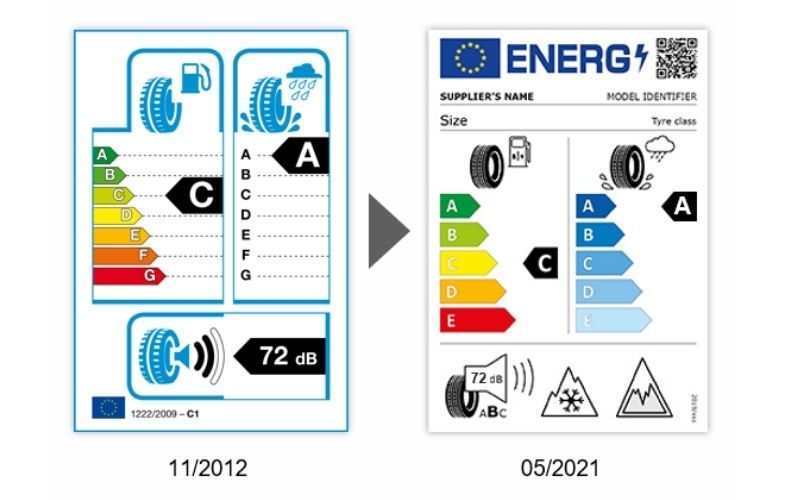
The new tyre label
Here’s how the new tyre label works:
The new label features the same three elements as the one introduced in 2012 – fuel efficiency, wet grip performance and noise.
However, it has been simplified, with the old A to G ratings replaced with ratings up to E.
The decibel image has also been changed. Instead of the audio bars showing the rating out of three, it is now shown with one of the letters A, B or C highlighted.
Snow and ice grip added to tyre ratings
The new label also has two icons of mountains. One is included to show whether the tyre is suitable for driving in snow, and the other is to indicate whether it can be used on ice.
Tyre label QR code
The new Energy Efficiency car tyre sticker, which also features the EU logo, should have a QR code. This allows motorists to get further information about the tyre from the European Product Registry for Energy Labelling database.
How do I change a tyre myself?
Watch this video from the RAC for learning how to change a tyre correctly by yourself.
Do you require a used wheelchair accessible vehicle? View our current range of stock here.
Please give us a call on 02392 245570 if you have any questions or need any assistance.
Browse some of our other articles:
- If electric vehicles are the future for everyone - does that include wheelchair users?
- 12 Top tips for looking after your wheelchair accessible vehicle 2021
- Digital driving licences to be introduced
- Top tips for improving fuel efficiency
- Best apps for wheelchair users 2021
- Buying a used WAV
- Best accessible museums to visit in 2021
- Best accessible beaches to visit in 2021
- How to prevent your catalytic converter from being stolen